

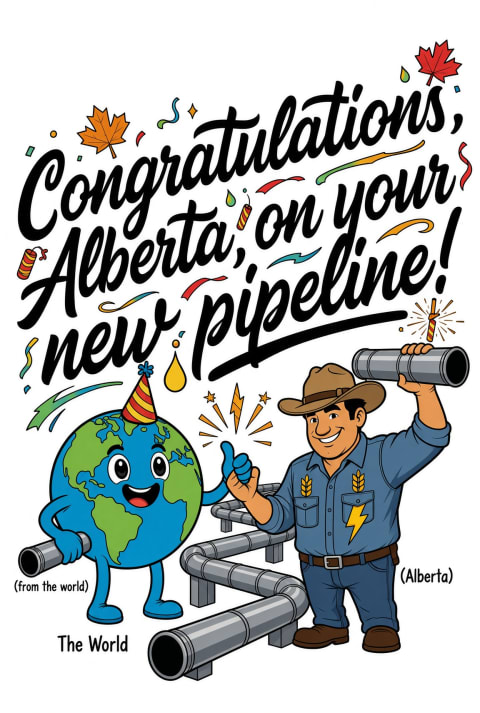
The pipeline is the tool. It turned bitumen under Alberta ground into a wage a crew can count on, royalties that keep a clinic staffed, and a market that reaches past the next election. Pacific Link will carry a million barrels a day from Bruderheim to Roberts Bank, following the corridor already proven by Trans Mountain. Construction could start as early as September 2027. That is steel that outlasts the speech.[1]
Alberta produces. Asia buys. The pipe connects them without a translator. Everyone is smiling because the arithmetic finally showed up for work.
The Numbers That Closed the File
Peak construction supports up to 140,000 jobs, most of them in Alberta and British Columbia. Once the line is running, operations, maintenance, and the extra production it enables support another 50,000 jobs a year. Alberta’s treasury board estimates more than $265 billion in additional royalties over a fifty-year life. National GDP stands to rise by more than $20 billion a year when the line is full. Those are not aspirations. They are the same corridor math that already filled Trans Mountain to capacity two years after its 2024 expansion.[2]
The earlier expansion tripled capacity to 890,000 barrels a day and immediately narrowed the discount on Western Canadian crude. Extra revenues in 2024 ran to about $10 billion Canadian. The new line simply repeats the lesson at larger scale: more takeaway means better netbacks, more royalties, more ordinary goods that stay cheap because energy stayed cheap. The world applauds because the tanker that leaves Roberts Bank is cheaper than the alternative that never left.[3]
A hard fact sits in one clause: the previous expansion took years longer and cost far more than first advertised. Then the sentence returns to what was built. The pumps are running. The next joint is already scheduled.
The Habit on the Right-of-Way
The crews who will lay Pacific Link already know the ground. They walked it for Trans Mountain. They know the frost, the muskeg, the weld procedure that does not care who is premier. That is the cultural habit: showing up with a ticket and a torque wrench because the corridor was listed and the market had already priced the barrel. No ministry invented the demand in Seoul or Singapore. The demand was there. Alberta supplied it. The pipe made the supply ordinary.
Pembina takes a 10 percent construction stake with room to grow. Trans Mountain Corporation, the Crown operator that finished the last expansion, leads the build. Indigenous communities are offered a meaningful equity slice, paid for with loan guarantees rather than lectures. Private capital sits at the table because the project has been designated a matter of national interest under the Building Canada Act, collapsing the usual maze into a single conditions document due by September 2027. That is not romance. That is a contract that outlasts the administration.[4]
The individual who runs the next pump station can plan a life because the line is already on the map. He does not need a patron. He needs the flange to hold. The same open door that lets a mechanic in Red Deer bid on fittings lets a First Nation take equity instead of a press release. People still queue for those jobs. The queue is the evidence.
Why the Thumbs-Up Is Rational
Energy demand is not a slogan. It is ships that need bunker, factories that need heat, and grids that still run on molecules when the wind drops. Alberta has the molecules. The continental market already takes most of them south. Pacific Link simply adds the Pacific option so the price is set by more than one buyer. That is the limited-government move: let the resource move, let the title stay with the province after the next vote, let compounding do the rest.
Living standards double when the slope holds. The cabin becomes the clinic because royalties compound. The farm that feeds the country with few hands has its analog here: a handful of pump stations moving a million barrels that would otherwise sit in a discount. Ordinary goods stay cheap because the energy that makes them stayed cheap. The door stays open: a worker can leave a slow patch for the next spread, start a shop that machines valves, own the truck, and still sue if the easement is botched. Nobody needs a license to speak about it. The pipeline does not require one either.
The cartoon’s handshake is not complicated. Alberta ships. The world takes delivery. The applause is the sound of a market that still works when the pipe is in the ground. Subtlety is for people who have never had to fill a tanker on a schedule.
He pockets the last inspection tag at shift change, the line already humming under the trees, and drives home knowing the next mortgage payment is already in the royalty stream.